The Era of Precision or Extinction: What Miami's Closed Storefronts Are Telling Every Entrepreneur
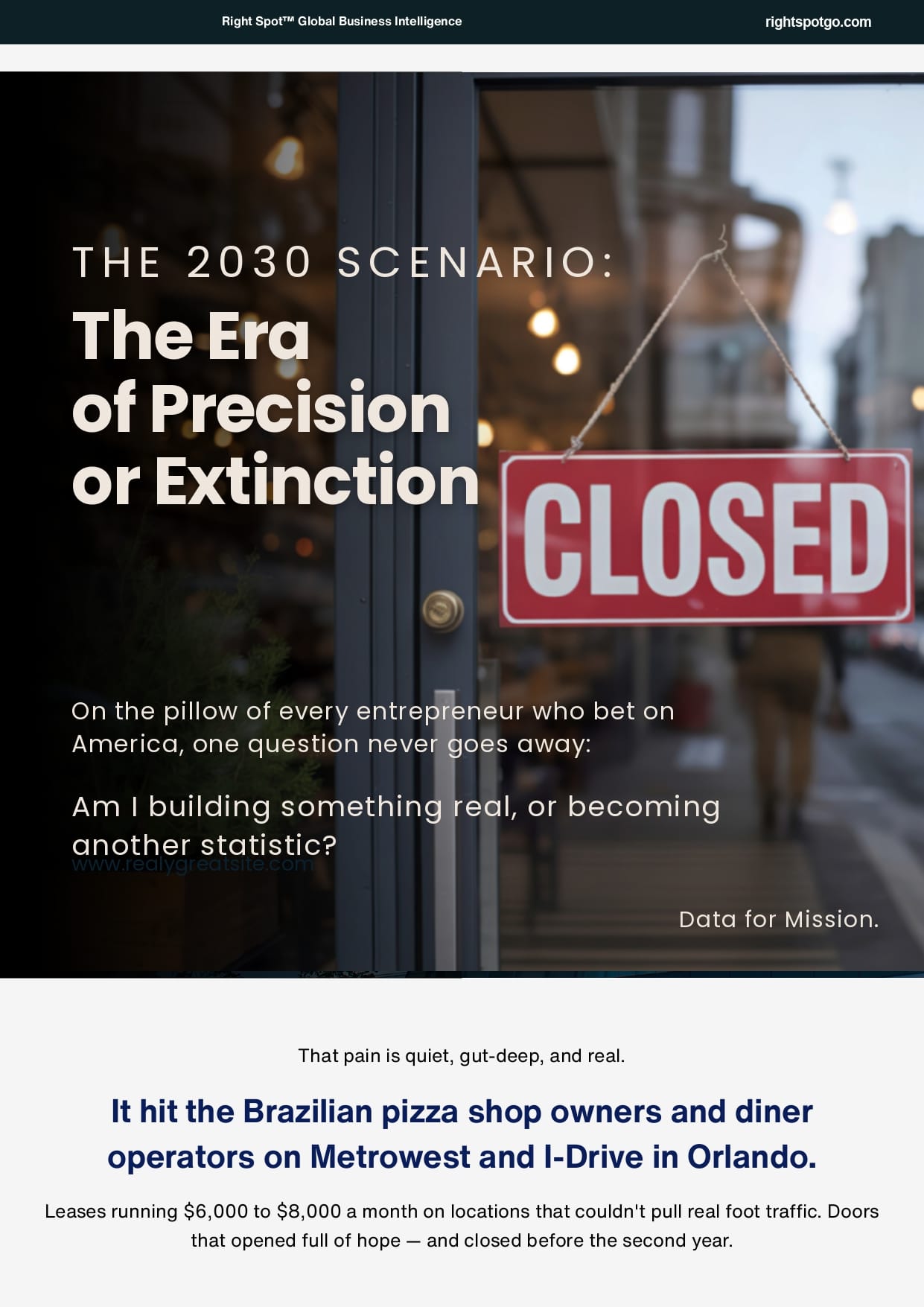
On the pillow of every entrepreneur who bet on America, one question never goes away.
It doesn't matter how full the dining room was that first Saturday. It doesn't matter how many five-star reviews came in during the first three months, or how many regulars were already asking when you'd open a second location.
Somewhere around month seven or eight, when the rent hits and the microloan payment clears and the foot traffic on a Tuesday looks nothing like it did on a Saturday, the question surfaces.
Am I building something real — or am I becoming another statistic?
That question is quiet. Gut-deep. And it's real.
It hit the Brazilian pizza shop owners and diner operators on Metrowest and I-Drive in Orlando. Leases running $6,000 to $8,000 a month on locations that simply couldn't pull consistent foot traffic. Doors that opened full of hope — and closed before the second year.
They had the work ethic. They had the product. They had the kind of grit that only someone who crossed an ocean to build something in America truly understands.
What they didn't have was the data.
What Actually Happened on Metrowest and I-Drive
This isn't a story about bad luck. It's not a story about people who didn't try hard enough or didn't want it badly enough.
It's a story about information asymmetry — and what happens when one side of a lease negotiation has decades of predictive analytics behind them, and the other side has a gut feeling and a Google Maps screenshot.
In under ten months, occupancy costs plus microloan interest drained the cash reserves. Not because the businesses were failing in any traditional sense — the product was solid, the customers were real — but because the math of a wrong location is brutally unforgiving.
A $7,500 monthly lease on a location generating $6,200 in realistic net revenue isn't a cash flow problem. It's a location problem. And it compounds every single month until the door closes.
The 2024/25 snapshot from Orlando isn't an outlier. It's a pattern. And based on everything the 2026 geopolitical and fiscal landscape in Florida is setting up, it's a pattern that's about to get more common, not less.
They Weren't Outcompeted. They Were Outgunned.
Here's what nobody tells the first-generation entrepreneur sitting across the table from a commercial broker.
On the other side of that table — and in the back office of every major retail chain, every institutional real estate investor, every franchise operator making multi-location decisions — there are teams running enterprise-grade predictive analytics. Foot traffic modeling. Demographic forecasting. Competitor proximity mapping. Lease benchmarking against real-time market comps.
They know, before they sign, exactly how many people walk past that storefront on a Tuesday afternoon in February. They know the household income profile within a half-mile radius. They know whether the anchor tenant two blocks over is about to pull out. They know if the city has a zoning variance in review that will change the traffic pattern in eighteen months.
The small business owner? They have the address, a walkthrough, and whatever the broker told them.
That information gap isn't a minor inconvenience. It's the difference between a thriving business and a ghost location quietly draining your capital every month until there's nothing left.
They weren't outcompeted. They were outgunned by the silent geoeconomics that major conglomerates have been running for decades.
Is It Still Worth Betting on Miami and South Florida?
This is the question that follows the pain. And it deserves a direct answer.
Yes. Unambiguously.
The Miami–Fort Lauderdale–West Palm Beach metro generates over $533 billion in GDP. Unemployment sits at 2.9% against a 4.3% national average. Retail vacancy in Miami-Dade holds at under 3% — one of the tightest markets in the country. Florida eliminated the state sales tax on commercial leases in October 2025, directly reducing occupancy costs for any business committing to a long-term space.
The market is real. The opportunity is real.
But the same conditions that make Miami attractive — low vacancy, high demand, institutional competition for good locations — are precisely what make entering without data so dangerous. In a loose market, a mediocre location is a manageable mistake. In a market this tight, it's a capital-destroying decision.
The answer to "is it worth it?" is yes — if you can see what you're actually committing to before you sign.
What the Sharpest Minds in the Industry Are Already Saying Out Loud
The shift has been visible for anyone paying attention.
The same analytical capabilities that institutional investors and national retail chains have been running for decades are now accessible — through AI-powered location intelligence platforms — to independent entrepreneurs, small business owners, and local operators.
The sharpest minds in the industry have been saying it plainly: "In today's environment, capital without command of AI tools is no longer an advantage — it's a liability. Precision is what sustains survival."
This isn't theoretical. It's operational.
The entrepreneurs who are building lasting equity in Miami's commercial market right now aren't the ones with the biggest budgets. They're the ones who made their location decision with the same rigor that the major conglomerates apply — demographic profiling, foot traffic modeling, income-to-rent ratio analysis, competitive saturation mapping — before committing a dollar to a lease.
What Is Geographic Vacuum — and Why It's Killing Good Businesses
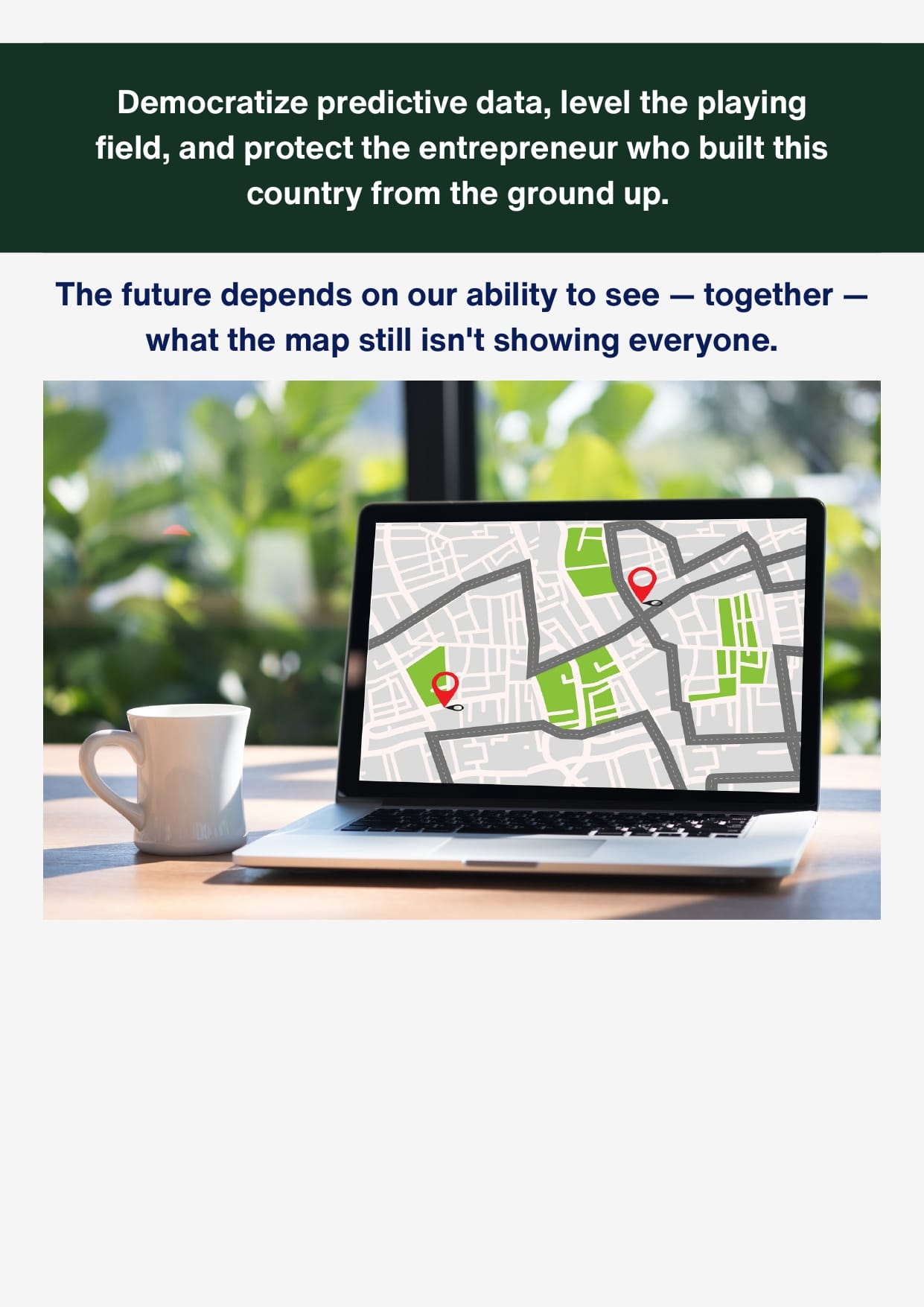
There's a gap between what Google Maps shows and what real commercial viability requires. We call it the geographic vacuum.
It looks like this: a location appears busy. The street has foot traffic. The neighborhood has energy. The broker says it's a hot corridor. You walk the space on a Saturday afternoon and everything feels right.
Then you sign. And you discover that Saturday afternoon foot traffic doesn't translate to Tuesday morning revenue. That the demographic density you assumed was there is actually two blocks over, on the other side of an invisible income boundary. That the anchor tenant generating the foot traffic you counted on has a lease expiring in eight months.
The geographic vacuum is the space between what your eyes tell you and what the data actually shows. It's where capital disappears. It's where the question on the pillow gets louder every month.
The way to cross the vacuum isn't courage. It's intelligence.
What Predictive Location Intelligence Actually Means for Your Business
Understanding whether a location is right for your specific business requires analyzing five interconnected dimensions simultaneously:
Attractiveness — Real foot traffic analysis, not estimated. Actual pedestrian and vehicle counts, broken down by day, time, and season. Miami's retail market is heavily seasonal; a location that looks healthy in January can be a cash drain from May to October if you don't account for the pattern.
Ecosystem — Urban synergy and saturation mapping. Which businesses near you will drive traffic toward your door, and which ones will absorb it before it reaches you? A restaurant adjacent to the right anchor tenant can capture passive demand. The wrong neighbor makes you invisible.
Demographics — Income density and psychographic profiling for the specific trade area. Not the city. Not the ZIP code. The walkable radius from your front door. Does the population within that radius match your price point, your product, your customer?
Structure — Legal viability and hidden adaptation costs. What isn't in the lease but will show up in the first six months: CAM charges, build-out requirements, zoning restrictions, parking constraints. The real occupancy cost is almost never the number on page one.
Decision — Stress testing and opportunity cost modeling. What does this location look like in eighteen months if the market moderates? What are you giving up by committing here versus two blocks away? What's the realistic downside scenario, and can the business absorb it?
These five dimensions, analyzed together before you sign, are the difference between a calculated commitment and an expensive guess.
The Future Depends on Seeing What the Map Still Isn't Showing
The 2026 landscape — immigration enforcement uncertainty, interest rate volatility, the World Cup effect compressing and then releasing consumer spending across South Florida — is creating a moment of genuine strategic complexity for anyone making a location commitment right now.
The entrepreneurs who will build lasting equity in this environment are the ones who can see through that complexity. Not by guessing correctly. By seeing what's actually there.
The data that major conglomerates have used to dominate commercial real estate decisions for decades is now accessible. The predictive intelligence that has separated institutional investors from individual operators — foot traffic modeling, demographic forecasting, certified location scoring — is no longer reserved for billion-dollar operations.
Democratizing that intelligence, leveling the playing field, protecting the entrepreneur who crossed an ocean or built from nothing in America — that's why Right Spot™ exists.
The map is about to show what it's been hiding.
The future belongs to those who see it first.
What the Map Doesn't Show Yet — And How to See It
Right Spot™ analyzes 25+ data points across five intelligence categories — Attractiveness, Ecosystem, Demographics, Structure, and Decision — and delivers a Certified Location Score that tells you, clearly, whether a location is worth your capital before you commit.
The full analysis is available now. Free, for those ready to see what the map doesn't show yet.
Results delivered instantly.
→ Get Your Free Location Viability Report at rightspotgo.com
Last spots available.
Disclaimer: The Right Spot™ Score Geoeconômico™ is a data intelligence tool and does not constitute a guarantee of financial return. All investment decisions carry inherent risk and should be made in consultation with qualified legal and financial advisors.